How to Use a Suede Brush: A Shoemaker’s Guide to 5 Tools
When you decide to care for your suede shoes, you'll find all sorts of brushes on the market.
It's not uncommon to wonder, "Which one should I actually use?"
With smooth leather shoes, you can brush off dust and nourish the leather with a leather conditioner cream. Applying cream is the key to the routine.
But with suede, you can't use cream. From removing dirt to restoring the nap and finishing, everything has to be done with brushes alone — that is what defines suede care.
This is why it is important to know how to choose and use the right brush for each situation.
In this article, I'll explain the features and usage of five tools: four types of brushes plus a suede eraser.
- Pig Bristle Brush
- Importance: ★★★★★
- Primary role: Daily dust removal and finishing
- Crepe Brush
- Importance: ★★★★☆
- Primary role: Surface dirt, scratches, and scuff marks
- Brass Brush
- Importance: ★★★☆☆
- Primary role: Glazed nap and caked-on dirt
- Multi-Purpose Brush
- Importance: ★★☆☆☆
- Primary role: All-in-one care with a single tool
- Suede Eraser
- Importance: ★☆☆☆☆
- Primary role: Spot dirt removal
If you have just begun building your cleaning kit, try using: 1. Pig Bristle Brush for daily maintenance and a 2. Crepe Brush for light dirt and scuff marks. These two brushes will cover the vast majority of situations.
In addition, add a 3. Brass Brush when you encounter glazed nap or caked-on dirt that the crepe brush can't handle. Build your cleaning kit by adding brushes in this order.
1. Pig Bristle Brush: Sweeping Away Daily Dust
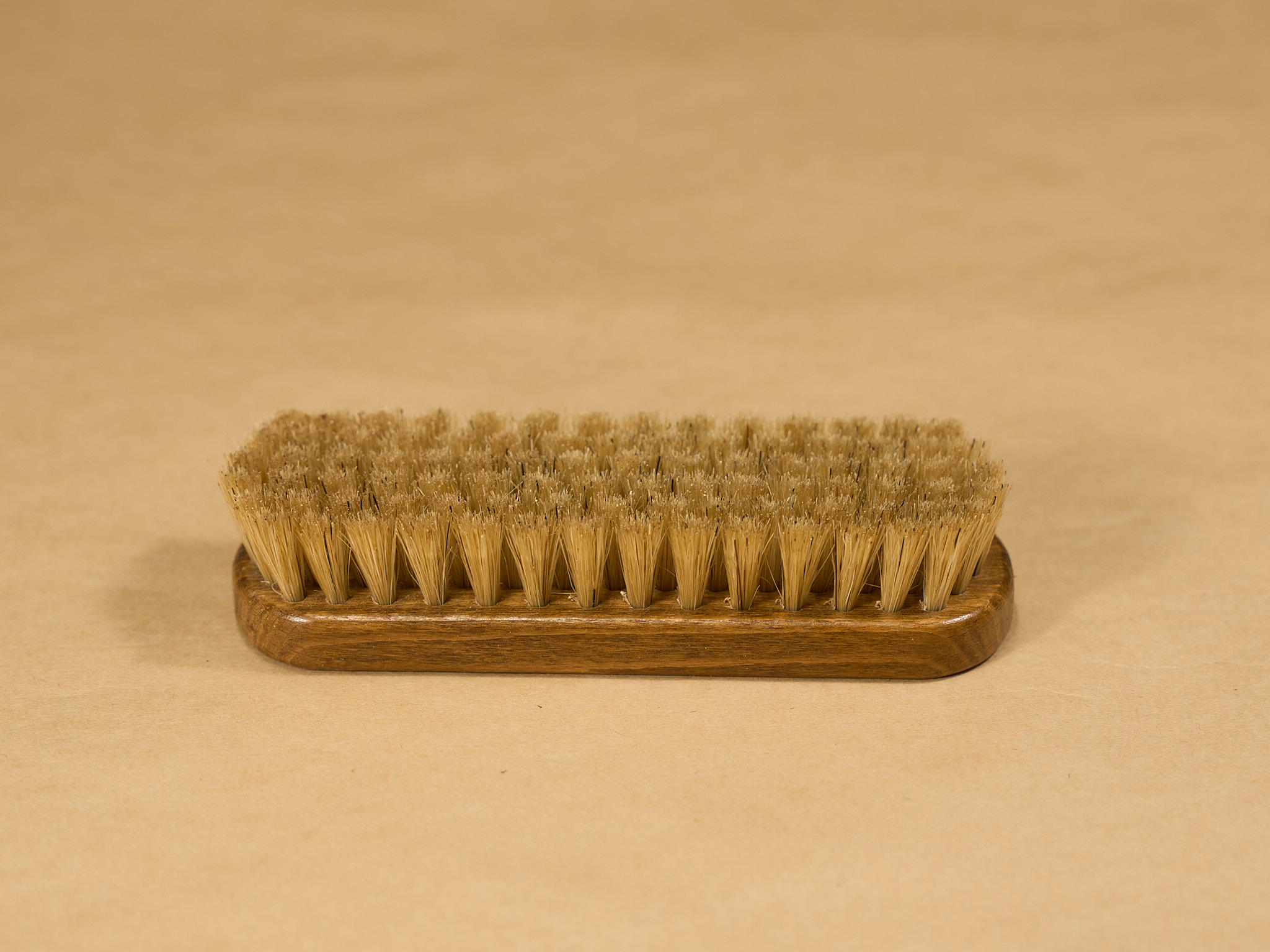
The pig bristle brush is the first tool you should have for your suede shoe care.
It can be used for everyday dust removal and smoothing the nap.
The firm stiffness of pig bristles flicks dust out of the suede fibers while vigorously realigning the nap.
For example, even suede shoes covered in dust, like the ones below, can be cleaned with this pig bristle brush.
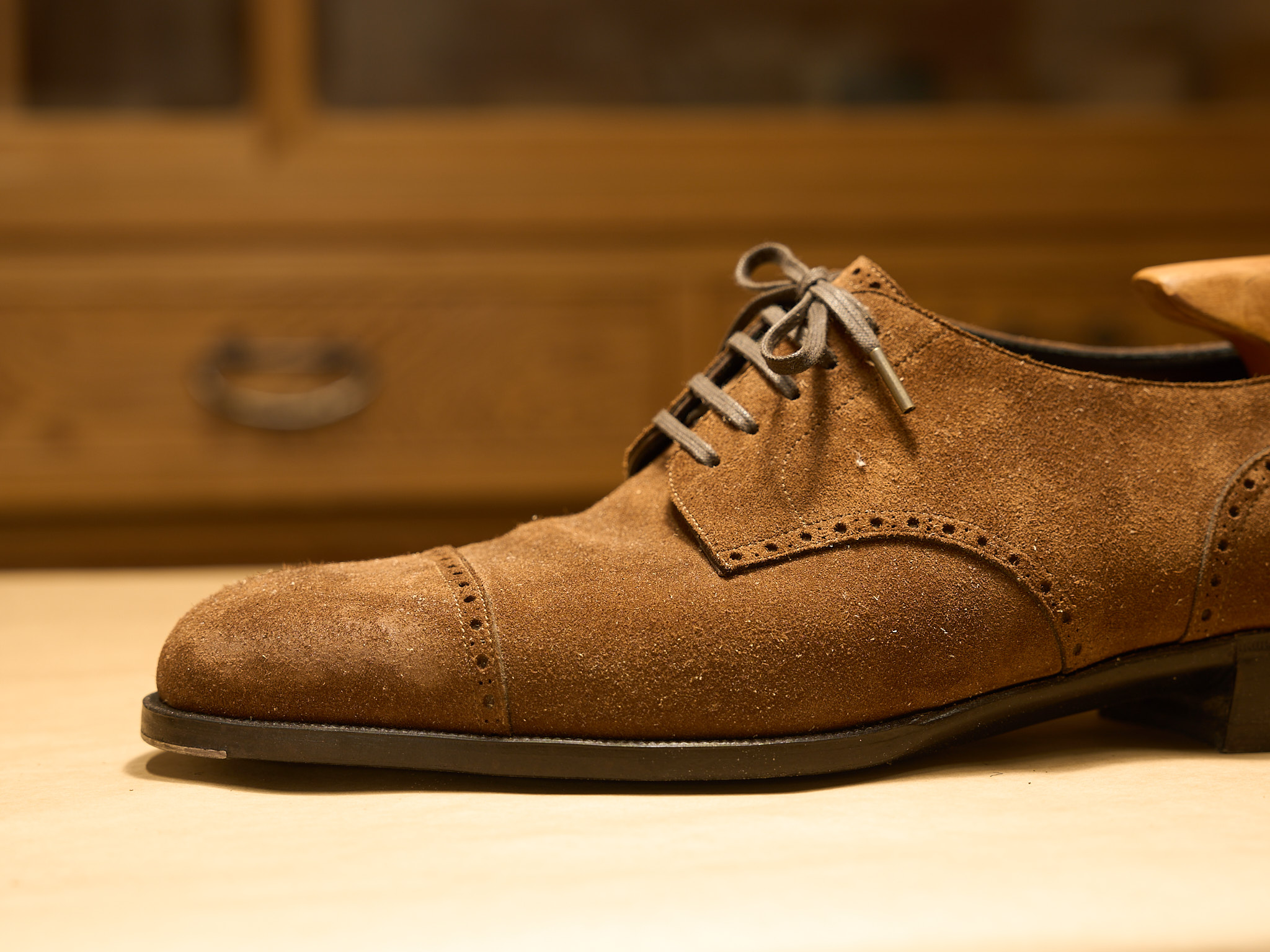
However, horsehair is longer and softer than pig bristle, so it's not ideal for digging out dirt lodged deep in the suede or firmly raising a flattened nap.
If you want to maintain the original texture of your suede for a long time, I recommend having a dedicated pig bristle brush.
How to Use the Pig Bristle Brush
Step 1: Remove the dust
First, remove all the dust from the entire shoe.
Using the bristle stiffness, brush the suede shoes in a sweeping motion across the surface.
Step 2: Smooth the nap
After cleaning off the dust, gently move the brush to align the nap in a consistent direction.
Suede is a material whose appearance changes depending on the direction of the nap because of how it reflects light.
When the nap is disheveled, it can look uneven in color or like dirt — even when the shoe is clean.
By aligning the nap direction, the light reflects uniformly, restoring a clean, like-new texture.
2. Crepe Brush: Removing Surface Dirt, Scratches, and Scuff Marks
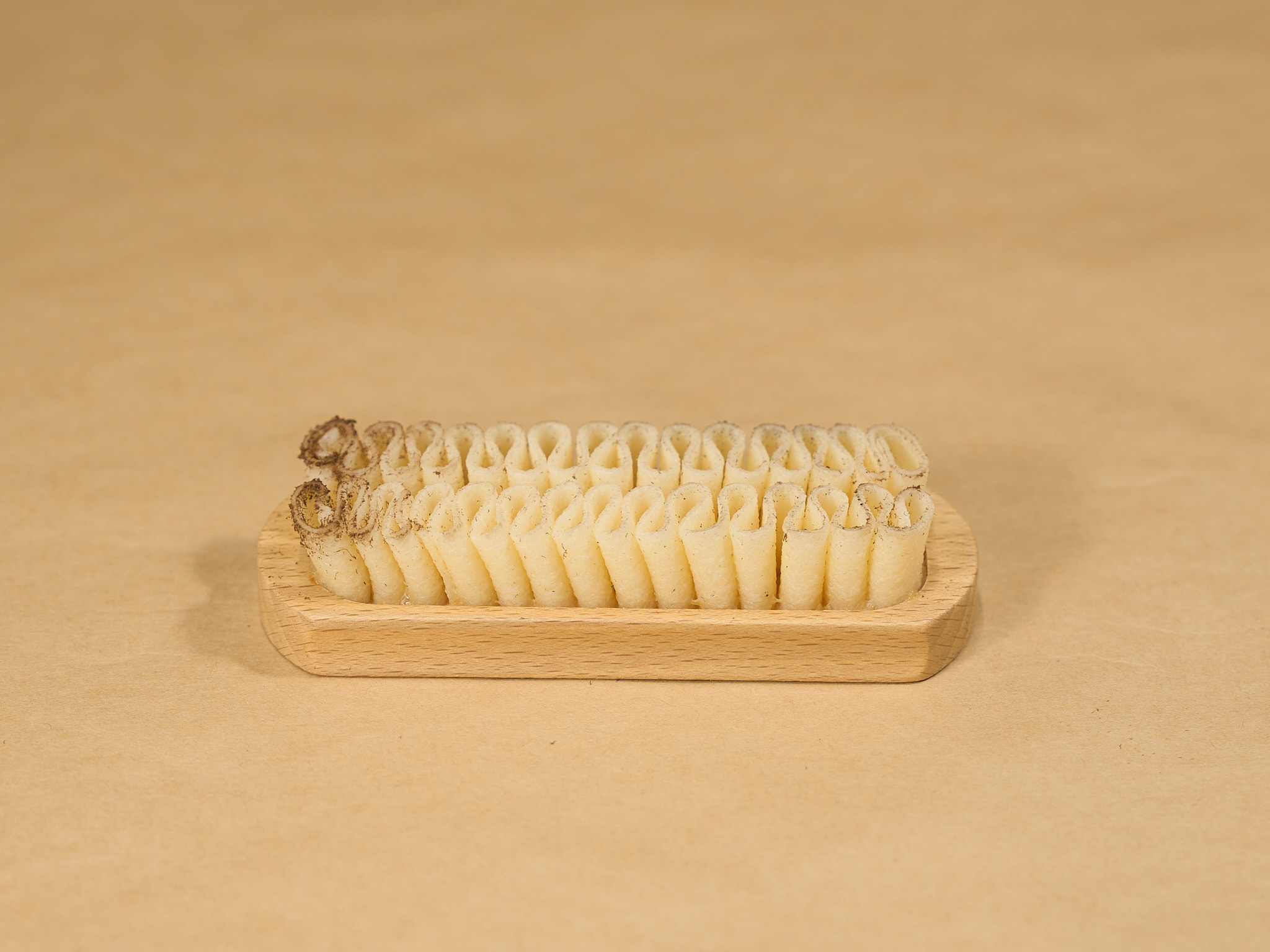
Unlike ordinary bristle brushes, a crepe brush has natural raw rubber attached to a handle. It's a tool specifically designed for suede.
It is used to remove dirt and can clean up scratches, scuff marks, and darkening.
Looking at the structure of a crepe brush, you can see layers of natural rubber overlapping in a wave-like pattern.
When you brush the shoe, these wavy rubber layers grip the suede fibers. The inherent tackiness of the rubber catches and pulls out dirt that has worked its way deep into the nap.
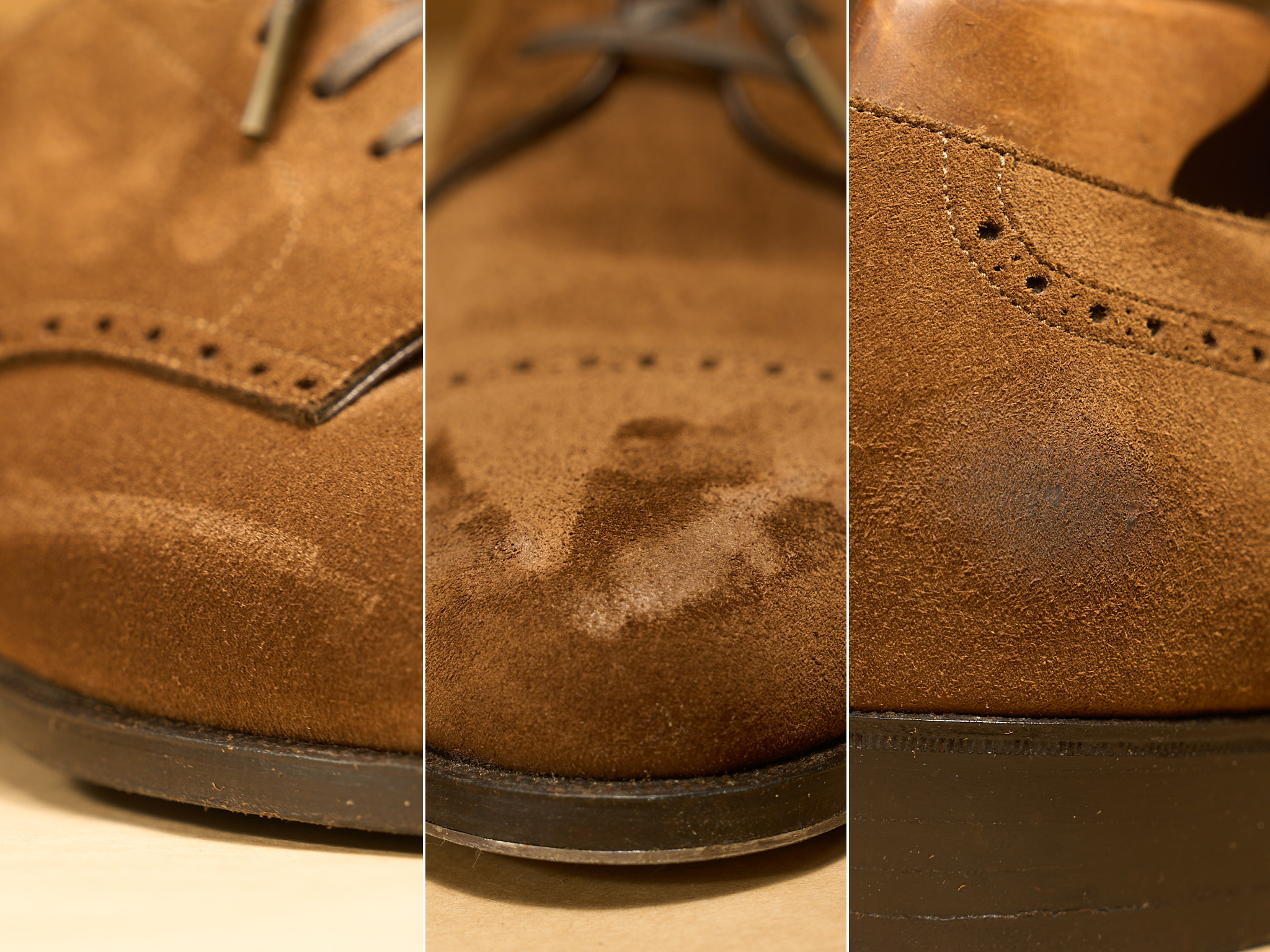
The firmness of the rubber also raises the nap effectively, which is why it can clean up scratches, scuff marks, and darkening, as shown in the examples below.
How to Use the Crepe Brush
Step 1: Use the edge of the brush to remove scratches, scuff marks, and dirt
Using the edge or corner of the brush, focus brushing on areas with noticeable scratches, scuff marks, or dirt.
Work the nap vigorously until the blemishes become less visible.
The key is to use a flicking wrist motion while applying moderate pressure.
Step 2: Use a lighter to even out the nap
Next, quickly pass a lighter flame over the suede surface.
After vigorous brushing with the crepe brush, the compressed fibers stand back up, but their lengths can become uneven.
By lightly passing the flame over the surface, you singe off the stray fibers that stick out, creating a smooth, uniform texture.
Keep your hand moving and lightly pass the flame across the surface.
Step 3: Smooth the nap
Once you remove the dirt and even out the nap, finish by smoothing it.
Brush gently in one direction with light pressure to align the nap.
You should now see the nap restored to its original direction, bringing back the soft, plush texture characteristic of suede.
3. Brass Brush: Tackling Glazed Nap and Caked-On Dirt
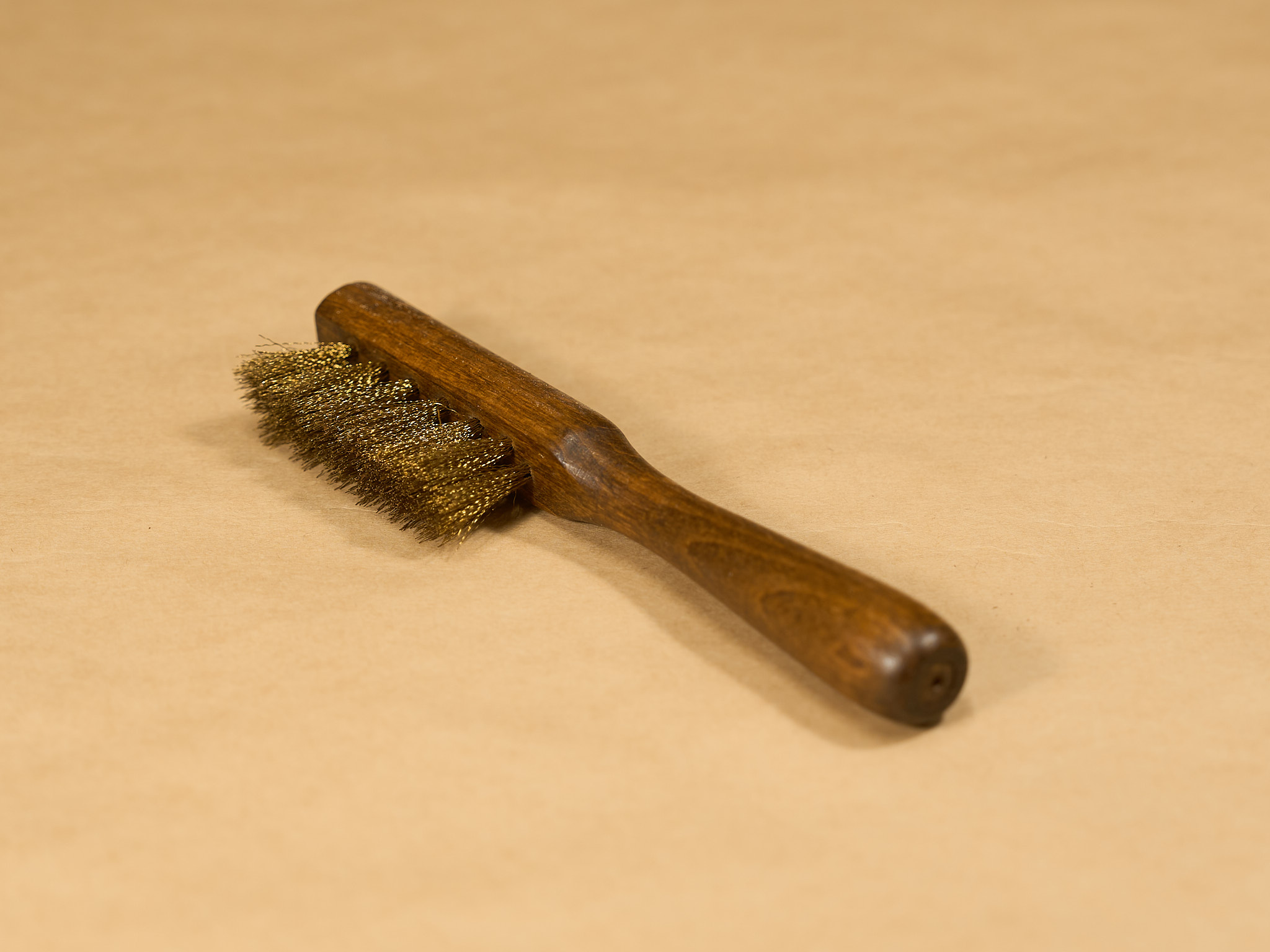
A brass brush uses fine brass wires to lightly brush the suede surface — it's a more aggressive care tool.
By removing a thin layer of the leather surface, it can eliminate glazed nap and caked-on dirt that pig bristle and crepe brushes can't handle.
The brass brush can abrade leather, meaning that overuse can damage it.
For minor scuff marks or dirt, try using the crepe brush first. Treat the brass brush as a more aggressive option for when other methods don't work well.
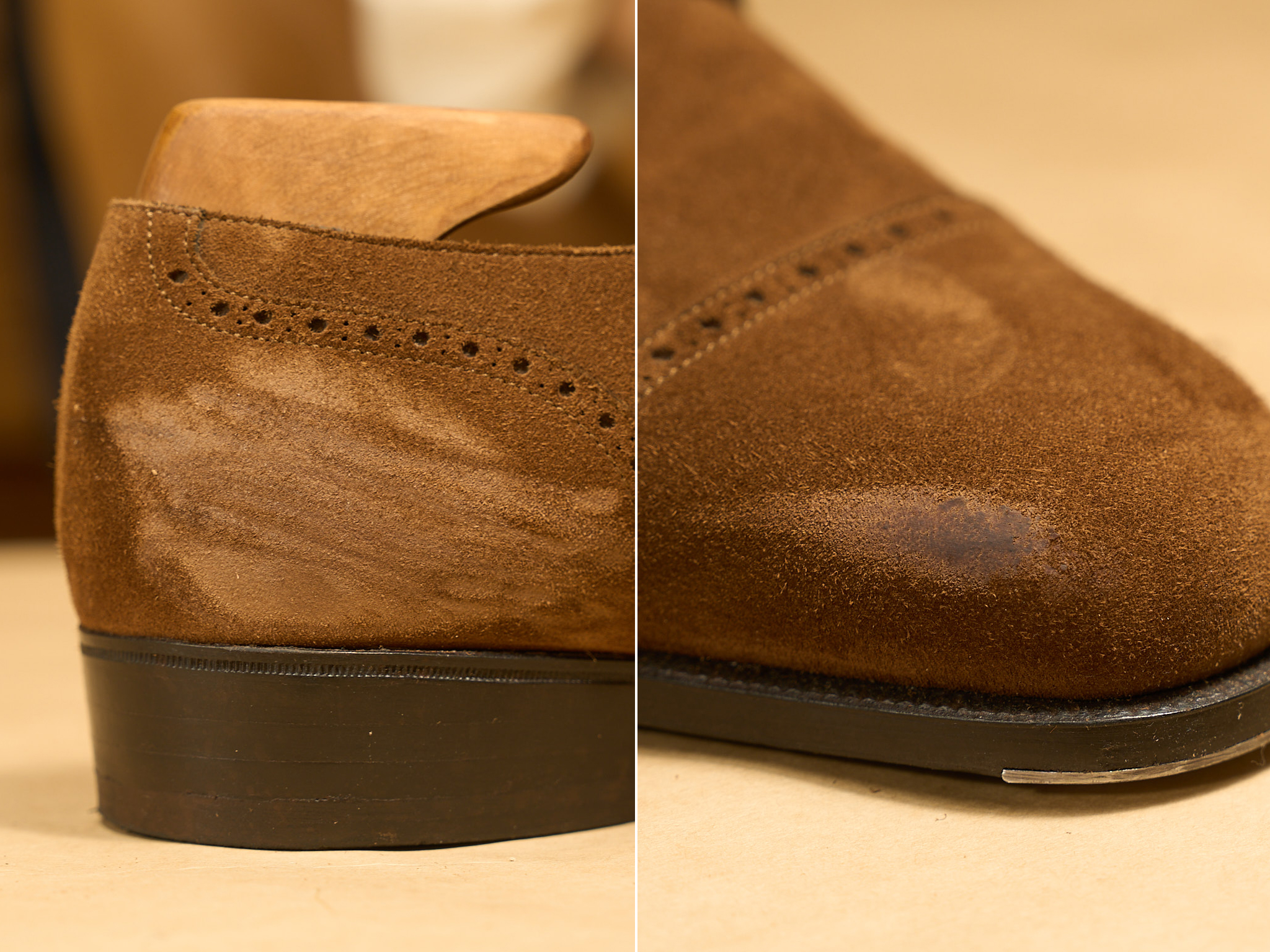
The brass brush excels at removing heavy scuff marks and caked-on dirt, as shown in the examples below.
How to Use the Brass Brush
Step 1: Gently abrade to remove dirt
Start by brushing lightly, scraping away the soiled layer.
Applying too much force right away can leave deep scratches, so begin gently.
Then, gradually increase pressure while checking your progress until the scuff marks or dirt are no longer visible — that's the key.
If the metal wires snag on the thread, they can fray instantly and damage it severely in the worst case.
When working near stitching, adjust the angle of the brush so that the wires don't directly catch the thread.
Step 2: Use a lighter to even out the nap
Next, quickly pass a lighter flame over the suede surface.
Brushing with the brass brush raises the compressed fibers, but it also leaves the nap uneven.
By lightly passing the flame over the surface, you singe off the stray fibers that stick out, creating a smooth, uniform texture.
Keep your hand moving and pass the flame very lightly across the surface.
Step 3: Smooth the nap
Once the scuff marks and dirt have been removed, finish by smoothing the nap.
The key is to brush gently with long strokes, as though you're softly smoothing out the surface.
Once the overall nap direction is aligned, you're done.
4. Multi-Purpose Brush: All-in-One Care with a Single Tool
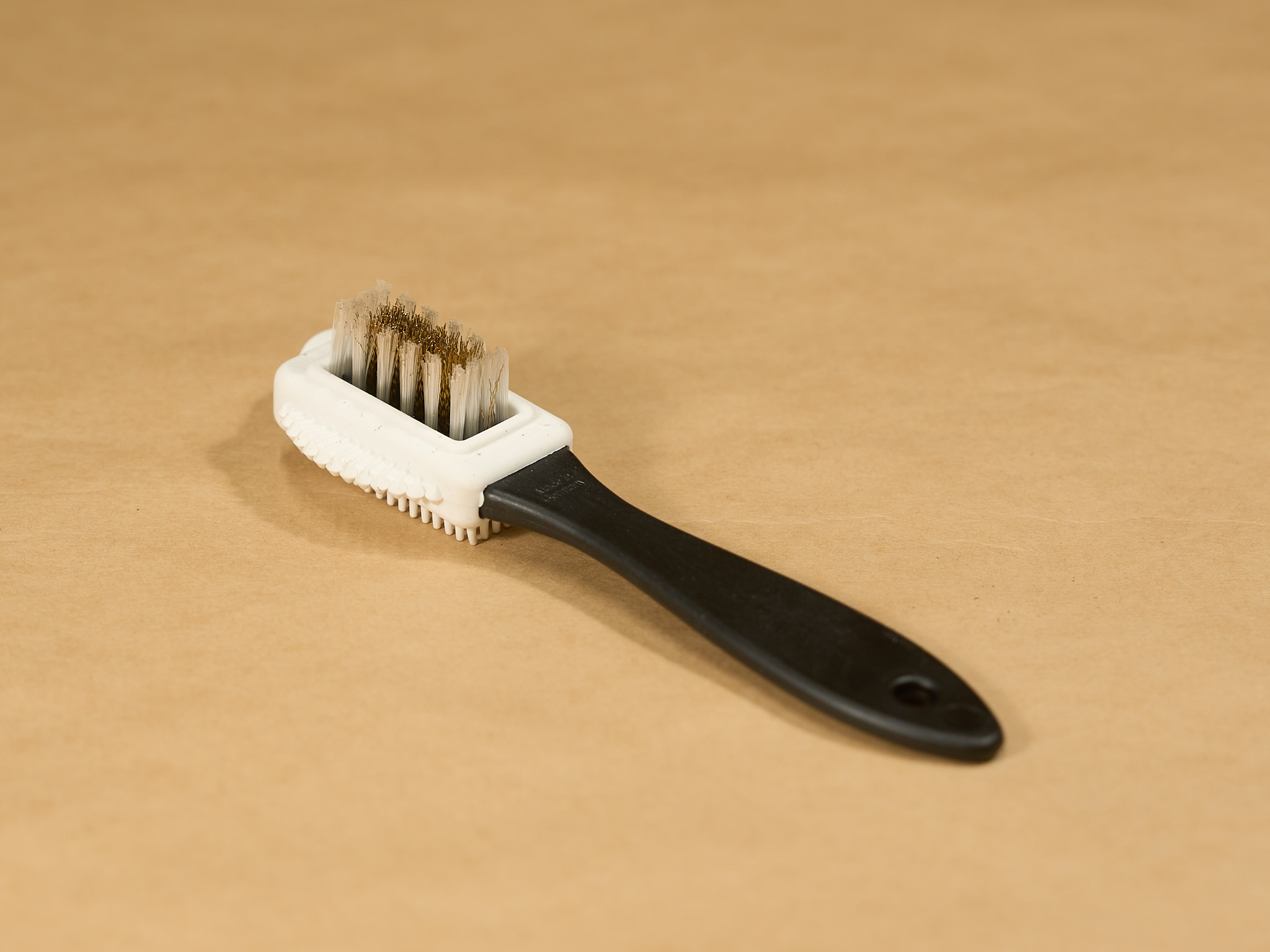
Multi-purpose brushes vary somewhat by product, but most of the brushes can be used on these types of surfaces:
- Brass and nylon combination brush
- Rubber brush (a surface with rubber nubs)
- Rubber scraper (a spatula-shaped edge)
Each brush surface serves a different purpose so that a single brush can handle a wide range of maintenance tasks.
That said, I personally don't use this brush very often. Because it tries to do everything, it can feel less effective than a dedicated brush.
Still, it covers all the basics, so it's a convenient tool to bring along when traveling.
Let me walk you through how to use each surface.
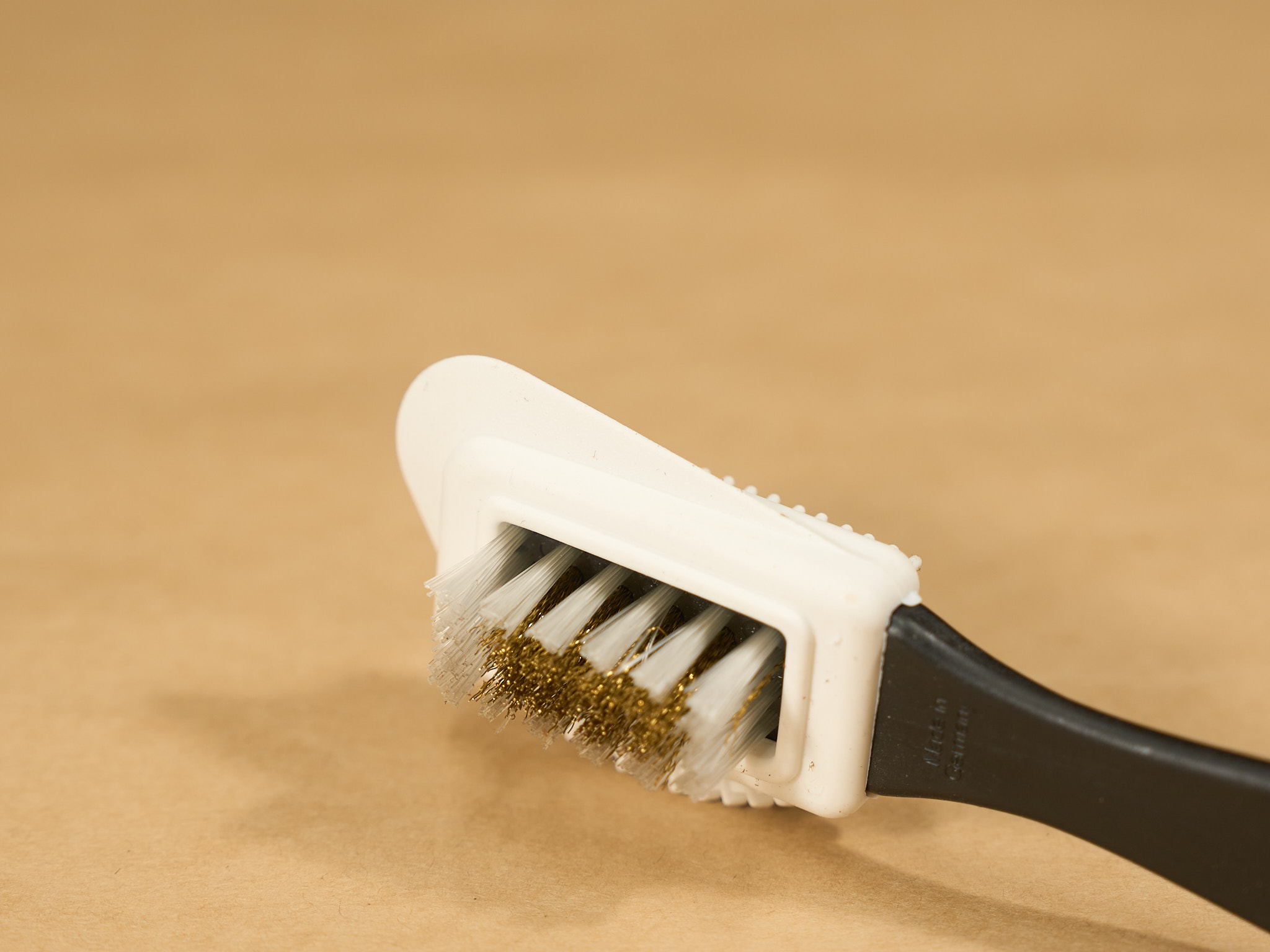
4-1. Removing Scratches, Scuff Marks, and Surface Dirt: Brass and Nylon Combination Brush
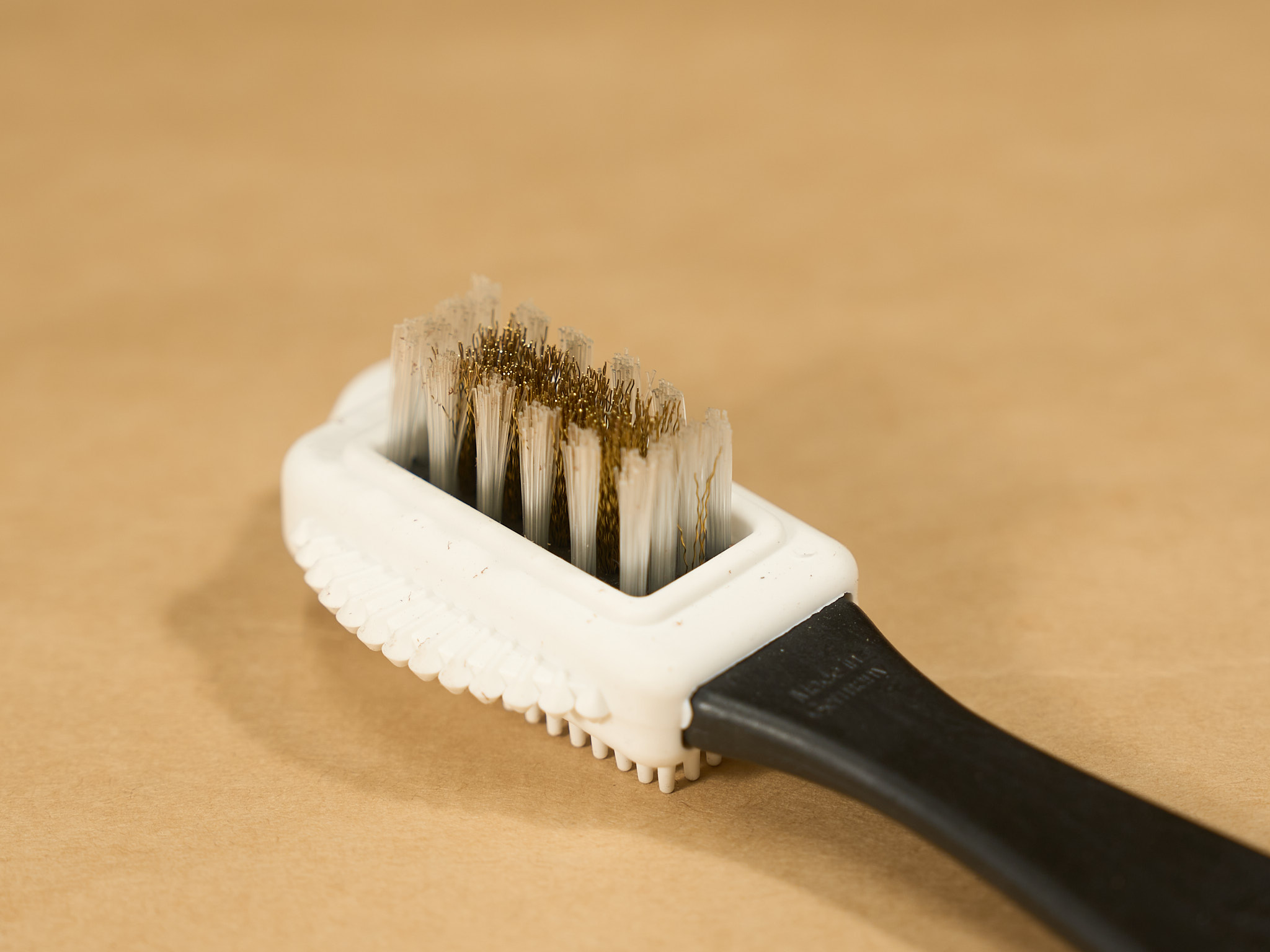
This brush surface is made of a mix of brass and nylon bristles and serves a dual role: removing scratches, scuff marks, and dirt, while also smoothing the nap.
The brass wire part can remove scratches, scuff marks, and dirt, while the surrounding nylon bristles can brush away debris and smooth the nap.
How to Use the Brass and Nylon Combination Brush
Step 1: Scrape away scratches and scuff marks with the brass bristles
Press the brass wire portion against the leather surface and move it as though lightly scraping away the grease and dirt.
The hardness of the brass lifts flattened fibers and strips away caked-on dirt.
Step 2: Smooth the nap with the nylon bristles
Brush away the scraped-off debris with the surrounding bristles while aligning the nap in a consistent direction.
The shoe care is now complete.
4-2. Removing Shine and Caked-On Dirt: Rubber Brush
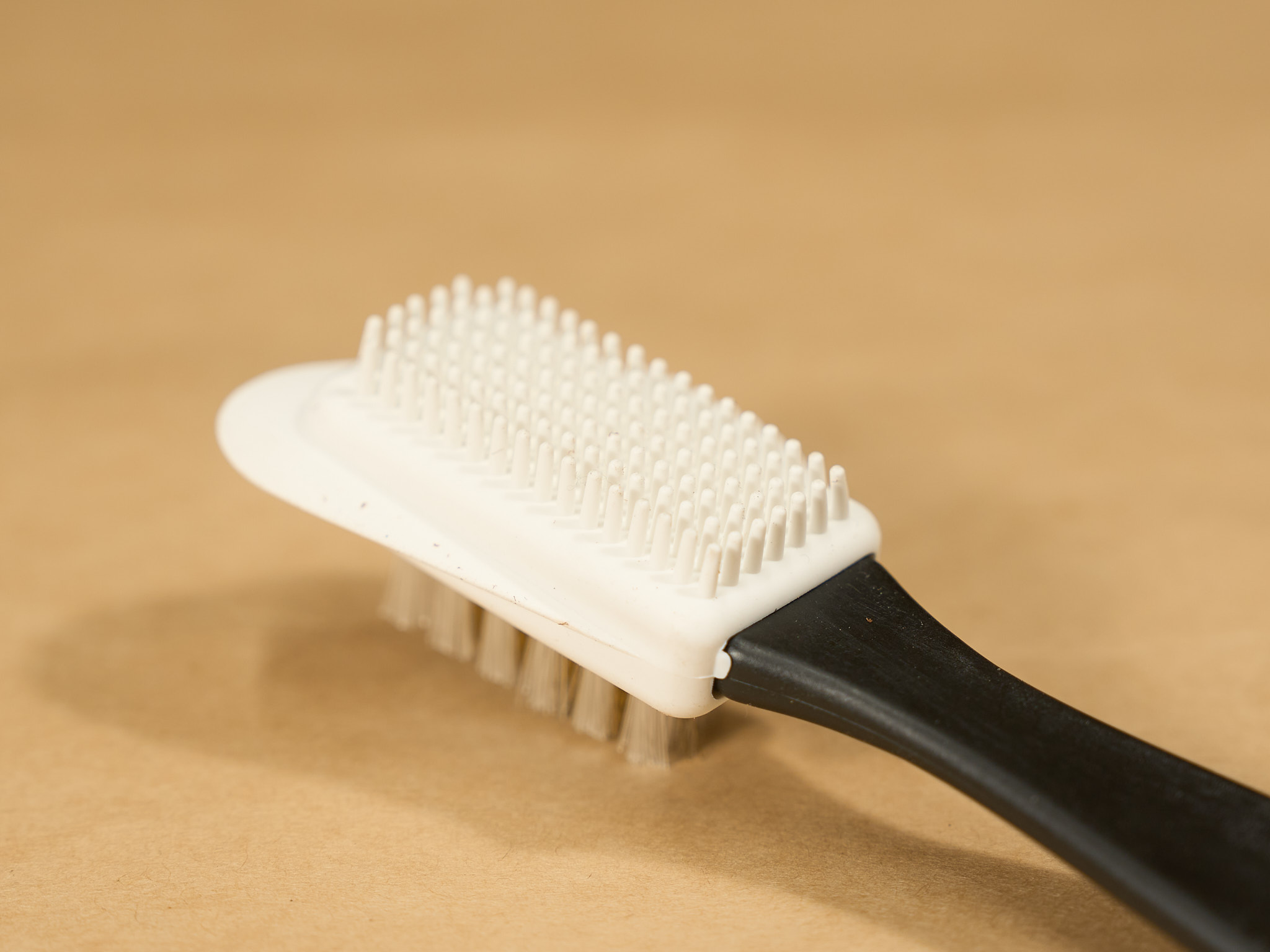
This surface, covered with rubber nubs, is ideal for addressing surface grease and caked-on dirt.
It aggressively lifts compressed, flattened fibers to eliminate greasiness and remove stubborn dirt from the surface.
How to Use the Rubber Brush
Step 1: Remove shine and caked-on dirt with the rubber brush
Use the rubber surface to brush areas with noticeable scratches or dirt.
The friction of the rubber lifts the fibers firmly from the root.
Continue brushing thoroughly until the scratches, scuff marks, or dirt are no longer visible.
Step 2: Smooth the nap with the combination brush
Once the dirt is removed, switch to the bristle surface to smooth the overall nap.
Gently stroke in one direction to align the fibers, and you're done.
4-3. Cleaning Tight Spots: Rubber Scraper
This spatula-shaped edge is designed for cleaning areas that the larger surfaces can't reach, such as around stitching and along the welt.
How to Use the Rubber Scraper
Press the rubber nub against the area you want to clean and rub it back and forth.
The key is to apply moderate pressure as you work.
Continue rubbing the shoe until the dirt is completely gone.
5. Suede Eraser: Pinpoint Dirt Removal
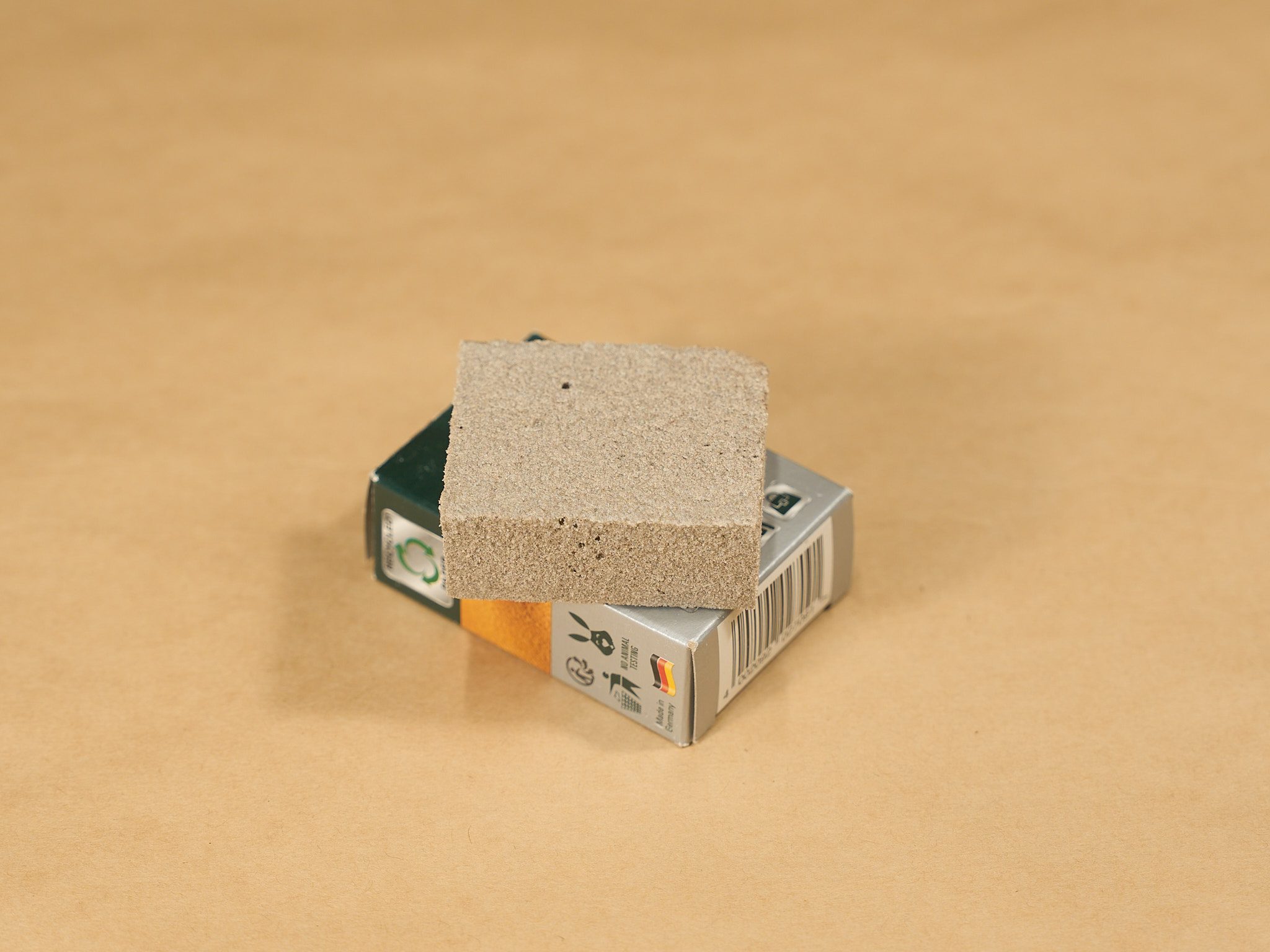
A suede eraser is a tool that allows you to remove dirt with pinpoint precision.
The eraser contains fine abrasive particles — think of it as an extremely fine sandpaper — that scrapes away dirt.
Since it can abrade the surface, it serves the same purpose as a brass brush. However, the eraser's biggest advantage is being able to target a specific spot precisely and safely.
A brass brush carries the risk of its metal wires snagging on a thread, making it difficult to use near stitching, as shown in the example below.
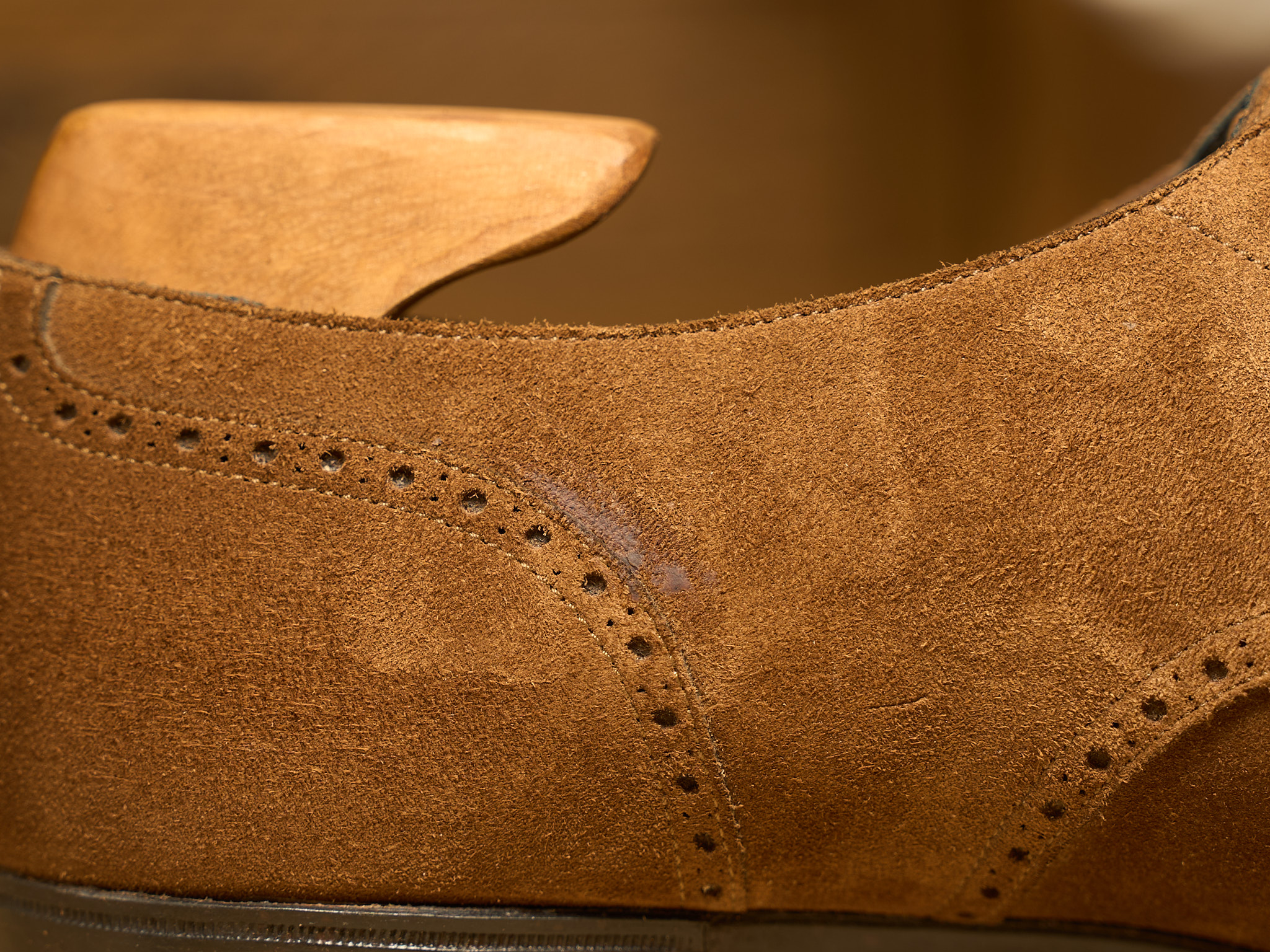
With a suede eraser, you can safely and accurately scrape away dirt right next to the stitching.
That said, a suede eraser might not be as useful as other brushes, ranking it lower compared to other brushes.
How to Use the Suede Eraser
Step 1: Rub away the dirt with the eraser
Press the corner of the eraser against the dirty area and rub the shoe while gradually increasing pressure.
If you rub the shoe too hard, you may actually push the dirt deeper into the leather. Work carefully, aiming to remove just the soiled surface layer, and check your progress as you go.
Step 2: Brush away the residue
Use a brush to remove the eraser residue.
If the eraser residue remains lodged in the suede fibers, it can attract new dirt.
Use a pig bristle brush to thoroughly brush away all the eraser residue.
That completes the eraser care process.
Here's a summary of the tools introduced above and the situations where each one shines. Choose the right tool based on the condition of your shoes.
- Pig Bristle Brush
- Importance: ★★★★★
- Primary role: Daily dust and polishing
- Crepe Brush
- Importance: ★★★★☆
- Primary role: Surface dirt, scratches, and scuff marks
- Brass Brush
- Importance: ★★★☆☆
- Primary role: Grease and caked-on dirt
- Multi-Purpose Brush
- Importance: ★★☆☆☆
- Primary role: All-in-one care with a single tool
- Suede Eraser
- Importance: ★☆☆☆☆
- Primary role: Pinpoint dirt removal
Can You Use the Same Brushes on Nubuck?
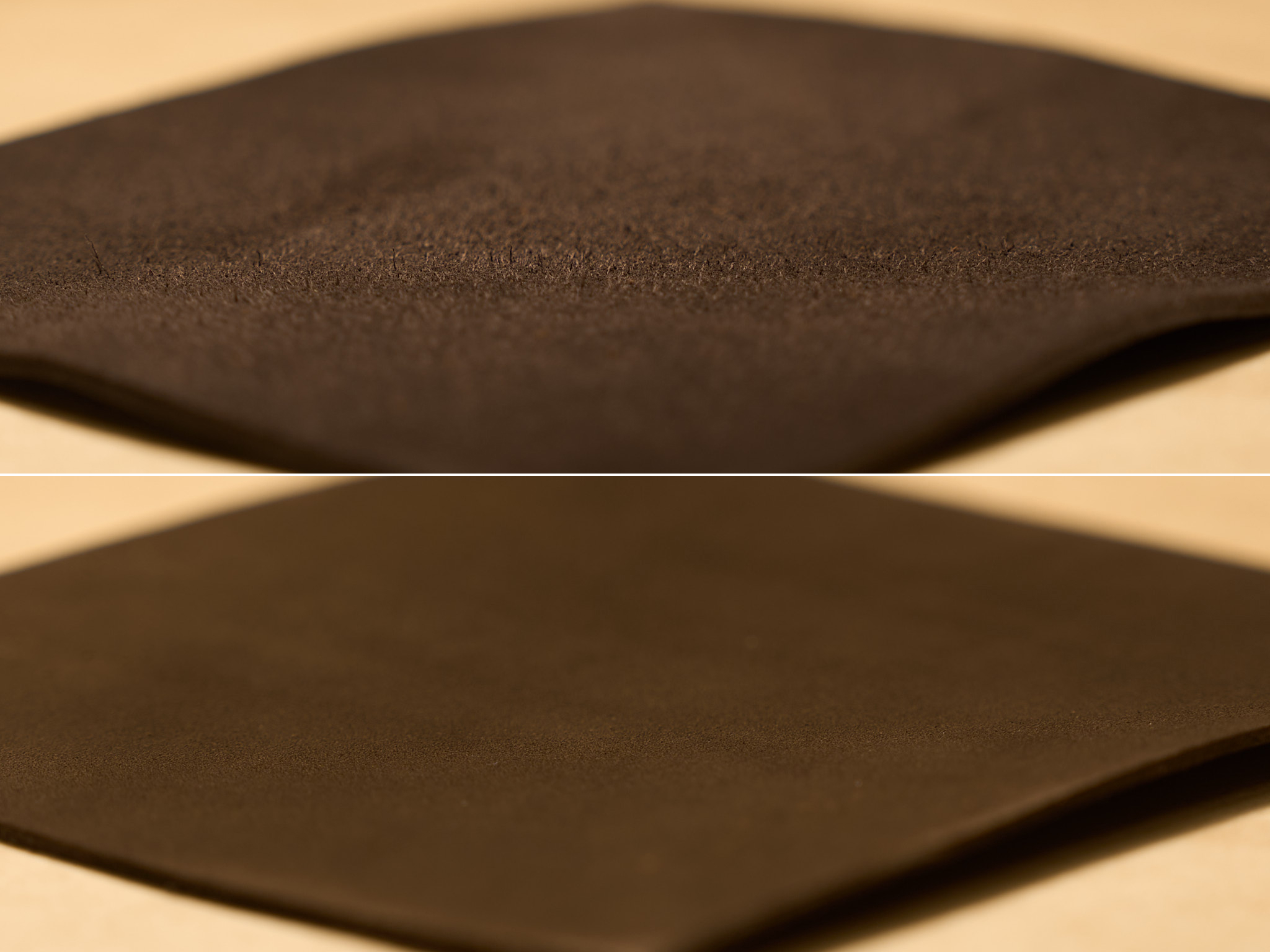
Nubuck is a type of leather that looks very similar to suede.
Most suede-specific care products on the market work for both suede and nubuck.
However, nubuck requires more careful handling than suede.
While suede is made by buffing the flesh side of the leather (called toko-men in Japanese) to raise the fibers, nubuck is made by sanding the grain side — the outer surface — with a fine abrasive to create a soft finish.
Nubuck has an extremely short nap compared to suede, giving it a silky, velvet-like texture.
To preserve this delicate texture, keep the following points in mind.
Use Light Pressure with Pig Bristle and Crepe Brushes
When caring for nubuck, the most important thing is to brush with very light pressure.
Nubuck scratches easily and is prone to developing an unwanted shine from friction, so applying too much force can change the nap's texture.
A light touch is enough to preserve nubuck's beauty for a long time.
Use Extreme Caution with the Brass Brush and Eraser
When using abrasive tools like the brass brush or eraser, proceed with extreme caution.
Nubuck is made by sanding the leather's surface to raise the fibers. If you sand too deeply, the coarser fiber layer underneath will be exposed.
Over-abrading with aggressive tools will destroy the delicate texture unique to nubuck, leaving the nap rough and coarse.
Using these tools once won't immediately ruin the texture, but avoid using them regularly. Reserve them for situations where the dirt is truly severe, and always proceed with caution.
Frequently Asked Questions (FAQ)
Here are answers to common questions about suede care.
Q. Can I use a toothbrush as a substitute?
A. You can, but it's not very efficient.
A toothbrush has a small surface area, and its bristles are made very soft to avoid damaging human gums. This makes it inefficient for smoothing the nap across an entire shoe, and it lacks the stiffness needed to remove scratches and scuff marks.
In addition, most toothbrushes are made of synthetic fibers (nylon, etc.). Compared to natural bristles, toothbrushes tend to generate more static, which can cause more dust to cling to the leather.
For these reasons, it's best to use dedicated suede care tools like the ones introduced in this article.
Q. Can I care for suede bags, belts, and wallets the same way as shoes?
A. The basic approach is the same, but be more careful when handling suede products than you would with shoes.
The suede used for bags and belts often has a finish that is softer and lighter than shoe-grade suede, and some pieces can be extremely delicate.
Start by testing with a soft horsehair or crepe brush, and adjust the pressure of the brush depending on how the material responds.
The harder brass brush can damage the texture by abrading the surface too aggressively, so use it only as a last resort for dirt that won't come off easily, and proceed with care.
Q. Does continued use of a brass brush shorten the leather's lifespan?
A. While it's not visible to the naked eye, strictly speaking, using the brass brush does shorten the leather's lifespan by a tiny amount.
A brass brush works by slightly abrading the surface to restore the nap. Each brushing session physically thins the leather layer, however marginally.
For this reason, it's best to limit its use to only in situations where the crepe brush can't handle the job — heavy scuff marks or caked-on dirt that clings to the fibers.
Using a pig bristle brush for everyday dusting and choosing the right tool for each purpose is the key to extending your leather's lifespan.
Q. How do I restore a darkened crepe brush?
A. You can restore its tackiness by removing the dirty surface layer.
If you keep using a crepe brush with a dirty rubber surface, you risk spreading the absorbed dirt to other areas of the shoe.
When the rubber looks noticeably dirty, use scissors to cut off a few millimeters from the tip, or lightly rub it against a concrete surface or sandpaper.
Once you remove the dirty layer, the original tackiness will be restored as the fresh rubber is exposed.
Suede care comes down to choosing the right tools and controlling your pressure.
Start by getting a pig bristle brush and a crepe brush, and begin incorporating them into your daily routine. That alone will make a significant difference in the condition of your suede shoes.
I hope this article helps you keep your favorite suede shoes looking great for years to come.